
The dinner rush: why your staff stop upselling when it gets busy
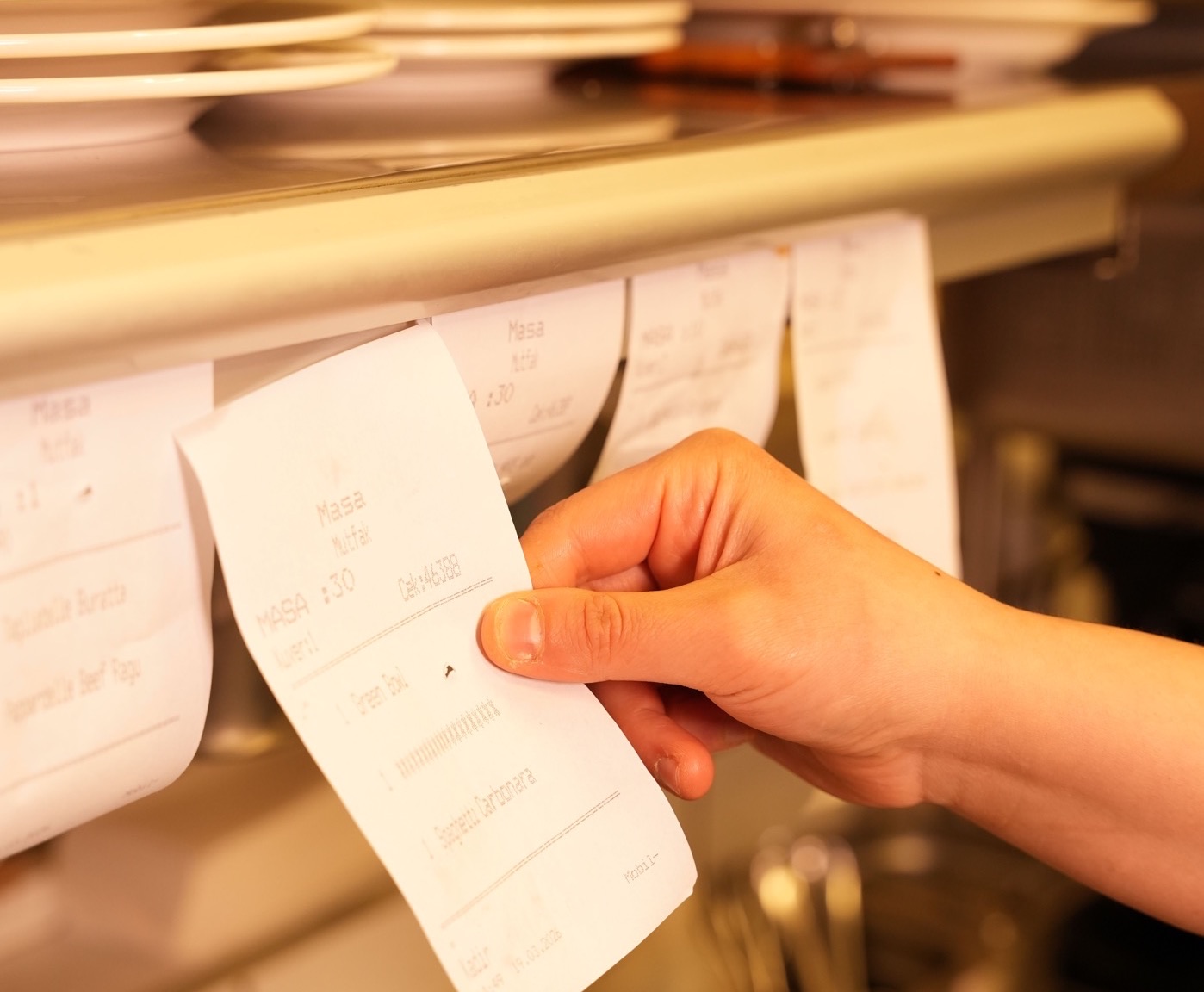
During the rush, your staff stop upselling because they choose speed, and researchers have measured it: in a US restaurant chain, once workload passed a certain point, servers cut back on sales effort to work faster [1]. Nobody decides to skip “Want a drink with that?” The question just drops out when the phone is ringing and the oven is full.
Big chains aren't immune: at US drive-thrus, an extra item was suggested on just 51.6% of visits in 2026, down from 57.5% in 2025 [3]. Here's where the trade-off comes from, how to spot it in your tickets, what it costs and how to keep asking when it's packed.
Why do staff stop upselling when it gets busy?
Because they're choosing between selling and speed. Tom Tan (Southern Methodist University) and Serguei Netessine (INSEAD) measured it in a study published in Management Science in 2014 [1], using point-of-sale data from a family restaurant chain in Massachusetts: nearly 200,000 transactions across five restaurants over 11 months [2]. The answer comes in two stages [1]:
- When things are calm, the more tables a server has, the more sales effort they make, even if service gets a little slower.
- Past a certain workload threshold, it flips: servers “start to reduce their sales efforts and work more promptly with the further rise in workload.”
Netessine put it from the server's point of view: “Of course at some point, if there are too many people allotted to me I get completely busy and I forget to suggest an appetiser, I forget to suggest more expensive wine, I simply don’t have time for this” [2].
One caveat: the chain in the study wasn't hitting that threshold on average, and the authors estimate it could even have cut staffing and sold about 3% more [1]. What matters is that the threshold exists. On the phone, you reach it fast: when one person is handling the call, the counter and the register, “Want a drink with that?” goes first, because it isn't needed to write down the order.
Do big chains remember to upsell?
Not as often as you'd think. Every year, Intouch Insight and QSR Magazine send mystery shoppers to the drive-thrus of 13 major US chains, at different times of day (2,145 visits in June and July 2026) [3]:
- In 2026, an extra item was suggested on just 51.6% of visits, down from 57.5% in 2025 [3].
- The same year, visits were the fastest since 2018, at 5:24 on average [3]. The study doesn't connect the two numbers, but it's the trade-off Tan and Netessine describe.
The same report compares 120 visits to drive-thrus where a voice AI assistant takes the order with other drive-thrus of the same three brands: the suggestion came on 79.2% of AI visits, versus 59.2% [3]. It's descriptive only (the AI locations were selected, not randomized), but the idea is simple: a machine doesn't have its hands full, and its instructions don't change with the crowd.
It's also what self-order kiosks do well, asking every customer the same question (see what kiosks do to the check). On the phone, that job can go to an AI voice agent like Soleir, which takes phone orders when your team can't pick up.
Does suggesting a drink slow down service?
Barely, if you ask at the right moment. In Intouch Insight's 2025 drive-thru study, suggestive selling improved speed of service only when it was offered after the order: visits averaged 5:28 in that case, versus 6:04 when the suggestion came with the greeting and 5:35 across the whole study [4].
These are observations, not an experiment. But the direction is clear: what costs time isn't “Want a drink with that?”, which takes two seconds. It's asking too early, before you know what's missing, or reading out the whole drink list. The exact line is in our guide to upselling on the phone. During the rush, the problem isn't how long the question takes. It's remembering to ask when your hands are full.
How can you tell if your team stops upselling during the rush?
Your tickets will tell you, with one week of phone orders:
- Make two piles: tickets from the rush (say 6 to 8 pm on Friday and Saturday, adjusted to your hours) and from quiet hours.
- In each pile, count the share of orders with at least one drink, then with a dessert.
- Compare. If the share drops during the rush, the question is probably being skipped.
One trap: a family at 7 pm doesn't order like a student at 3 pm. For a fairer comparison, put two similar evenings side by side, a quiet Friday and a busy one, or ask your team to tick the ticket whenever they asked.
Lost sales per month = phone orders during the evening rush × gap in drink share × drink price × nights open
Here's an example for a pizzeria, with assumptions to replace with your own counts: 24 phone orders during the evening rush; a drink in 50% of orders during quiet hours and 35% during the rush, a 15-point gap; a $2.50 can of soda; 26 nights a month (six nights a week).
Result: 24 × 15% = 3.6 fewer drinks a night, × $2.50 × 26 nights = $234 a month, or $2,808 a year.
| Gap in drink share | Fewer drinks per night | Per month | Per year |
|---|---|---|---|
| 10 points | 2.4 | $156 | $1,872 |
| 15 points | 3.6 | $234 | $2,808 |
| 25 points | 6 | $390 | $4,680 |
This is revenue, not profit: subtract what each can costs you. The same math works for dessert and for the lunch rush.
How do you keep upselling when it's packed?
Since the problem is workload, you either take the question off your team's mind or take the phone out of their hands:
- Ask before the read-back. Never read back an order without asking first. A “Drink? Dessert?” note on the phone helps, but the rush is exactly when nobody looks at it.
- Someone on the phone during the rush. It works, but it's an extra paycheck when every pair of hands counts (see how much staff time phone calls take).
- An AI voice agent. Its instructions are the same on the first call of the night and the thirtieth.
That's what Soleir does. It answers when your team can't and takes the order from your menu, with options and extras. At the end of the order, it can suggest a drink or a dessert, once, and only if the order doesn't already have one: no means no. The rule is the same at 8 pm on a Friday as at 3 pm on a Tuesday, because it doesn't depend on who's free. Then it reads the order back to the caller and sends it to the restaurant: a ticket printed in the kitchen, plus a text and an email alert.
Your team stays on the oven and the counter. Whatever you choose, rerun the ticket test before and after: it's the only way to know the question is really being asked.
Sources
- Tom F. Tan (Southern Methodist University) and Serguei Netessine (INSEAD), Management Science 60(6), “When Does the Devil Make Work? An Empirical Study of the Impact of Workload on Worker Productivity”, 2014. scholar.smu.edu
- INSEAD Knowledge, “Labour Efficiency: Workloads or Makework?”, 2012. knowledge.insead.edu
- Intouch Insight with QSR Magazine, “26th Annual Drive-Thru Study”, 2026. go.intouchinsight.com
- Intouch Insight with QSR Magazine, “25th Annual Drive-Thru Study”, 2025. go.intouchinsight.com
Sources checked on October 20, 2026.
Common Questions
Because they trade sales effort for speed. In a 2014 Management Science study of a US restaurant chain, servers made more sales effort as their workload rose a little, then cut back once it passed a certain threshold, to work faster. During the rush, suggesting a drink is the first thing to go, because it isn't needed to take the order.
Not much, if you ask after the order. In Intouch Insight's 2025 US drive-thru study, visits averaged 5 minutes 28 seconds when the suggestion came after the order, versus 6 minutes 4 seconds when it came with the greeting. What wastes time is asking too early or reading out the whole drink list.
Split one week of phone order tickets into two piles: rush hours and quiet hours. In each pile, count the share of orders with a drink, then with a dessert. If the share drops during the rush, the question is probably being skipped. Compare two similar evenings if you can, since customers order differently at different times.
At US drive-thrus in 2026, an extra item was suggested on 79.2% of visits where a voice AI assistant took the order, versus 59.2% at other locations of the same brands, according to Intouch Insight (a descriptive comparison). On the phone, Soleir can suggest a drink or a dessert once per call when one is missing, at any hour.
Keep reading


Never Miss Another Restaurant Call
Stay updated with the latest Soleir features restaurant AI insights to your inbox.