
Suggesting a drink on the phone: the small sentence that grows the ticket

Suggesting a drink on the phone grows the ticket, and it has been measured: when cashiers at a self-service restaurant suggested orange juice, it went from 20% of breakfasts sold to 35-42% [4]. On a $30 phone order (plug in your own average), a $2.50 soda adds about 8% to the ticket of every caller who says yes.
Yet on the phone, the question often gets skipped. In 12,091 recorded restaurant calls analyzed by Revmo, a phone software vendor, only 28.6% of calls to pizza restaurants included an upsell attempt [1]. Here's what the research shows, the exact line to use, and the math with your own numbers.
Does suggesting a drink really increase sales?
Yes, and it's one of the few upselling moves tested in a real restaurant. In a field experiment published in 2015, researchers at Wageningen University in the Netherlands had cashiers at a self-service restaurant suggest a side to breakfast customers (orange juice, fruit salad or pancakes), using four different prompts over 13 weeks [4]. Compared with the baseline period:
- Orange juice: 35-42% of breakfasts sold included one in the weeks it was suggested, up from 20%.
- Fruit salad: from 3% to 9%.
- Pancakes: from 1% to 3%.
Just as useful: a survey of 393 customers found they didn't feel pressured into buying a side [4]. A simple suggestion didn't come across as a hard sell.
It wasn't on the phone, but the moment is the same: one person, one question, as the customer finishes ordering. It's also how self-order kiosks work. According to researchers at the University of Hamburg, kiosks automatically offer other products and consistently ask, for example, whether you'd like a coffee with your meal [5]. We look at what that does to the check in our article on self-order kiosks.
How often do restaurants upsell on the phone?
Not often, judging by the two US data sets we found:
- On the phone: Revmo, which sells AI phone agents, analyzed 12,091 recorded restaurant calls in a 2026 report. Pizza restaurants had the best answer rate of any segment (93.1%), yet only 28.6% of their calls included an upsell attempt [1]. That's one vendor's recordings, not a national benchmark.
- At the drive-thru: in Intouch Insight's annual study with QSR Magazine, mystery shoppers made 2,145 visits to 13 chains in June and July 2026. An extra item was suggested on 51.6% of visits, down from 57.5% in 2025 [2].
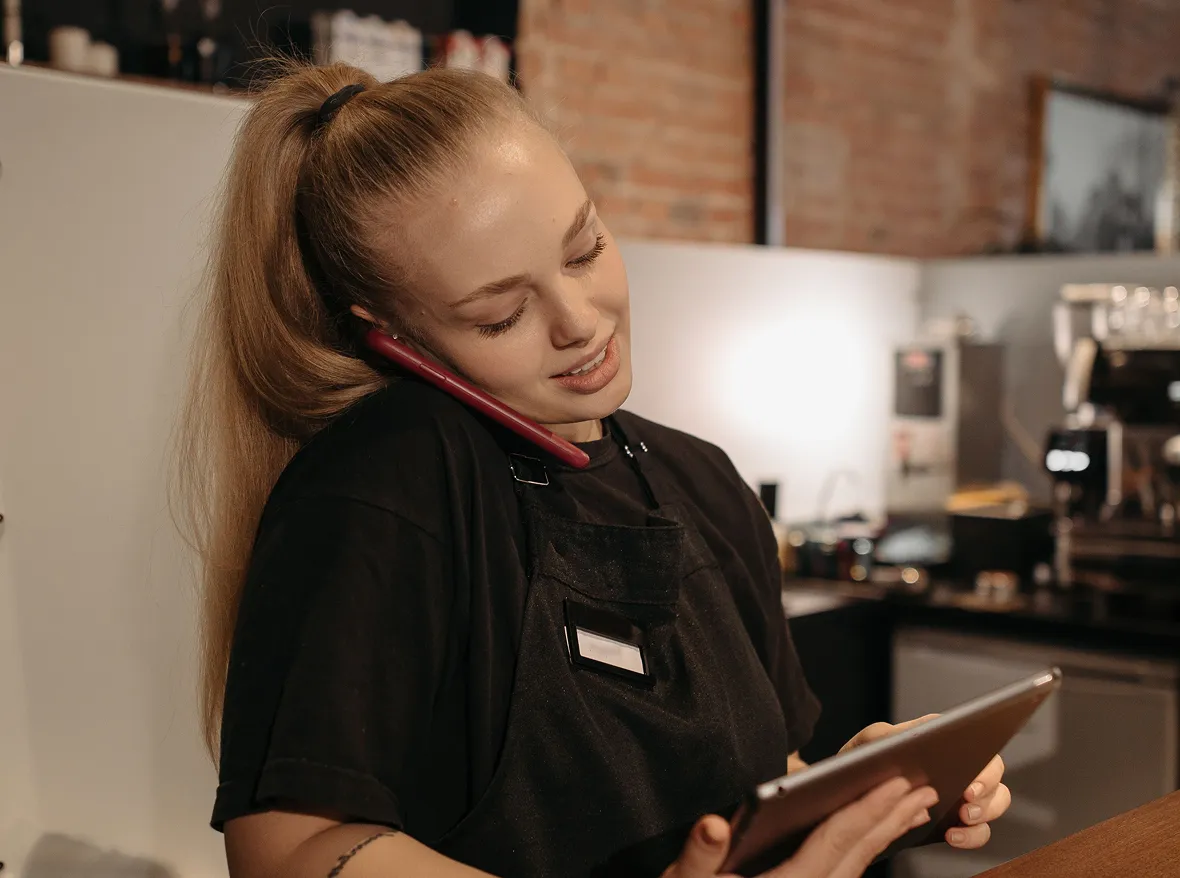
It's easy to see why the question gets skipped. On a Friday night, with the phone wedged against your shoulder, the oven full and three people waiting at the counter, whoever picks up wants one thing: get the order right and hang up. The drink is the first thing to go.
What should you say to upsell a drink on the phone?
The method fits in five rules, and it's the kiosk's method: the same question, for every customer, with no pressure.
- One suggestion per call. No means no: don't push, and don't pitch something else right after.
- Target what's missing. No drink in the order? Suggest a drink. A drink but no dessert? Suggest dessert. Both already there? Skip it and read back the order.
- After the order, not at hello. At US drive-thrus in 2025, visits averaged 5 min 28 s when the suggestion came after the order, versus 6 min 04 s when it came with the greeting [3]. The study found suggestive selling improved speed of service only when it came after the order. And until the order is done, you don't know what's missing.
- Short and specific. “Want a drink with that?” is enough. If they hesitate, give two or three options, not the whole list.
- Every call. A kiosk's edge is consistency: ask on half your calls and you'll sell half the add-ons.
On the phone, it sounds like this:
“Two medium pizzas, one pepperoni and one four-cheese. Want a drink with that?” And if they hesitate: “We have sodas, iced tea and bottled water.”
How much can upselling a drink add?
You can run the math in a minute, with five numbers you know or can count:
Extra sales per month = phone orders per day × share of orders with no drink × share of callers who say yes × drink price × days open per month
Here's an example for a pizzeria. Every input is an assumption, to replace with yours:
- Phone orders: 30 a day.
- Orders with no drink: half. Check a week of tickets.
- Callers who say yes: 1 in 5. That's more cautious than the Dutch study: 3 extra drinks per 30 orders is 10 points, while orange juice gained 15 to 22.
- Drink price: $2.50 for a can of soda.
- Days open: 30 a month.
Result: 30 × 1/2 × 1/5 = 3 extra drinks a day, × $2.50 × 30 days = $225 a month, or $2,700 a year. Depending on how many callers say yes:
| Callers who say yes | Extra drinks per day | Per month | Per year |
|---|---|---|---|
| 1 in 10 | 1.5 | $112.50 | $1,350 |
| 1 in 5 | 3 | $225 | $2,700 |
| 3 in 10 | 4.5 | $337.50 | $4,050 |
Two caveats. This is revenue, not profit: subtract what each can costs you. And the same math works for dessert, at your dessert price. To find your real yes rate, ask on every call for two weeks and tally the yeses.
How do you keep upselling during the dinner rush?
The line is easy. Saying it on every call is the hard part. A few options, from simplest to most complete:
- A note on the phone. “Drink? Dessert?” right where whoever answers can see it.
- Ask before the read-back. Never read back an order without asking first, and it becomes a habit.
- Someone on the phone during the rush. It works, but it's an extra paycheck during your busiest hours (see how much staff time phone calls take).
- An AI voice agent. It answers when your team can't and takes the order from your menu. Soleir, for example, can suggest a drink or a dessert once, and only if the order doesn't already have one. The rule doesn't change with the clock: it's the same at 8 pm on a Friday as at 3 pm on a Tuesday. It reads back every order before sending it to the restaurant, and it tells callers it's an AI at the start of the call (see what diners want from an AI phone agent).
Whatever you choose, measure it: count the drinks sold on phone orders for two weeks before and two weeks after. If nothing moves, first check that the question is really being asked.
Sources
- Revmo, “State of Restaurant Calls 2026 (press release)”, 2026. revmo.ai
- Intouch Insight with QSR Magazine, “26th Annual Drive-Thru Study”, 2026. go.intouchinsight.com
- Intouch Insight with QSR Magazine, “25th Annual Drive-Thru Study”, 2025. go.intouchinsight.com
- Wageningen University (van Kleef, van den Broek and van Trijp), Applied Psychology: Health and Well-Being, “Exploiting the Spur of the Moment to Enhance Healthy Consumption: Verbal Prompting to Increase Fruit Choices in a Self-Service Restaurant”, 2015. pubmed.ncbi.nlm.nih.gov
- University of Hamburg (interview with Karen Gedenk), “Effects of self-service kiosks on buying behavior”, 2023. uni-hamburg.de
Sources checked on October 4, 2026.
Common Questions
Ask one short question after the order, and only if the order has no drink: “Want a drink with that?” If the caller hesitates, offer two or three options. If they say no, drop it and read back the order. In a 2015 field experiment at a self-service restaurant, customers offered a side by the cashier didn't feel pressured into buying one.
At the end of the order, right before the read-back. In the 2025 US drive-thru study by Intouch Insight and QSR Magazine, visits averaged 5 minutes 28 seconds when the suggestion came after the order, versus 6 minutes 4 seconds when it came with the greeting. Before the order is done, you also don't know what's missing.
Multiply your phone orders per day by the share with no drink, the share of callers who say yes, the drink price and your days open. With 30 phone orders a day, half of them without a drink, 1 caller in 5 saying yes, a $2.50 soda and 30 days open, that's about $225 a month in extra sales, before the cost of the cans.
Not necessarily. In a 2015 field experiment by Wageningen University, surveyed customers didn't feel pressured, while the share of breakfasts sold with orange juice rose from 20% to 35-42% when cashiers suggested it. What annoys people is pushing, so make one suggestion, keep it short, and take no for an answer.
Keep reading

Never Miss Another Restaurant Call
Stay updated with the latest Soleir features restaurant AI insights to your inbox.